
15 Privacy Trees Along Fence Ideas For Year-Round Screening And Curb Appeal
A bare fence often fails to give a yard real privacy. Neighbors can still see in, and the space may feel exposed. This guide shows how the right trees along a fence can create a natural privacy screen that blocks views, reduces noise, and adds structure to the yard.

This article explores a range of privacy trees, from tall evergreens and narrow columnar varieties to flowering hedges and broadleaf screens. It covers fast growers, compact options, and trees that stay green all year. Each idea helps homeowners choose trees that fit their space, climate, and privacy needs.
1) Arborvitae for year-round evergreen privacy

Arborvitae creates dense, green coverage along a fence in every season. It keeps its foliage all year and forms a tight screen when planted close together.
Popular types like the Green Giant arborvitae grow quickly and reach tall heights. Many Thuja varieties also work well as evergreen privacy trees in small or large yards.
2) Leyland Cypress for rapid growth and dense foliage

Leyland cypress grows fast and forms thick, evergreen foliage. Many homeowners use it to create a natural screen along fences.
Experts note its value as a fast-growing tree for privacy. Plant trees about 5 to 10 feet apart, as explained in this guide on how far apart to plant Leyland cypress for privacy.
3) Thuja Green Giant for a tall, fast-growing screen

Many homeowners choose the Thuja Green Giant tree for height and privacy. It grows quickly and keeps its green color year round.
It handles wind well. It also needs little care once established, making it a practical fence line screen.
4) Italian Cypress for a narrow, vertical privacy barrier

Italian cypress grows tall and slim, making it ideal for tight fence lines. It forms a strong vertical screen without taking much ground space.
Many gardeners choose it for tall, narrow privacy screens. Plant trees in well-drained soil and full sun for best results.
5) Eastern Red Cedar for drought-tolerant privacy

Eastern Red Cedar offers dense, year-round coverage along fence lines. It handles heat, cold, and dry soil with ease. Many homeowners choose it for tough sites.
This native evergreen supports birds and wildlife. Learn more about its habitat value from the University of Maryland Extension on Eastern Redcedar.
6) Japanese Cedar for a textured, evergreen fence line

Japanese cedar adds soft texture and steady green color along a fence. It keeps its foliage year round, which helps block views in every season.
It works well in privacy rows like other evergreen trees for privacy and screening. Plant trees with space for roots and mature width.
7) Wax Myrtle for fragrant and dense greenery

Wax myrtle is a fast growing evergreen that works well along fences. It forms thick foliage that helps block views.
Many gardeners choose wax myrtle for privacy hedges because it can grow up to five feet in one season.
Plant shrubs about five to six feet apart for a tight screen, as advised for spacing fast growing wax myrtle for privacy. It tolerates drought and adapts to many soils.
8) Emerald Green Arborvitae for a slender, compact hedge

Emerald Green arborvitae forms a narrow, upright hedge that fits tight fence lines. It keeps dense, year-round foliage.
Many homeowners choose Emerald Green arborvitae trees for privacy screens. They grow well in full to part sun and need little pruning.
Plant them 2 to 3 feet apart for a solid, compact border.
9) Bamboo for fast growth and sound buffering

Bamboo creates a tall, dense screen along a fence line. Many types grow several feet per year, making them strong fast-growing privacy plants.
Clumping varieties stay controlled and form thick coverage. Some types also offer moderate sound reduction, as noted among bamboo sound barrier options.
10) Photinia for colorful privacy hedges
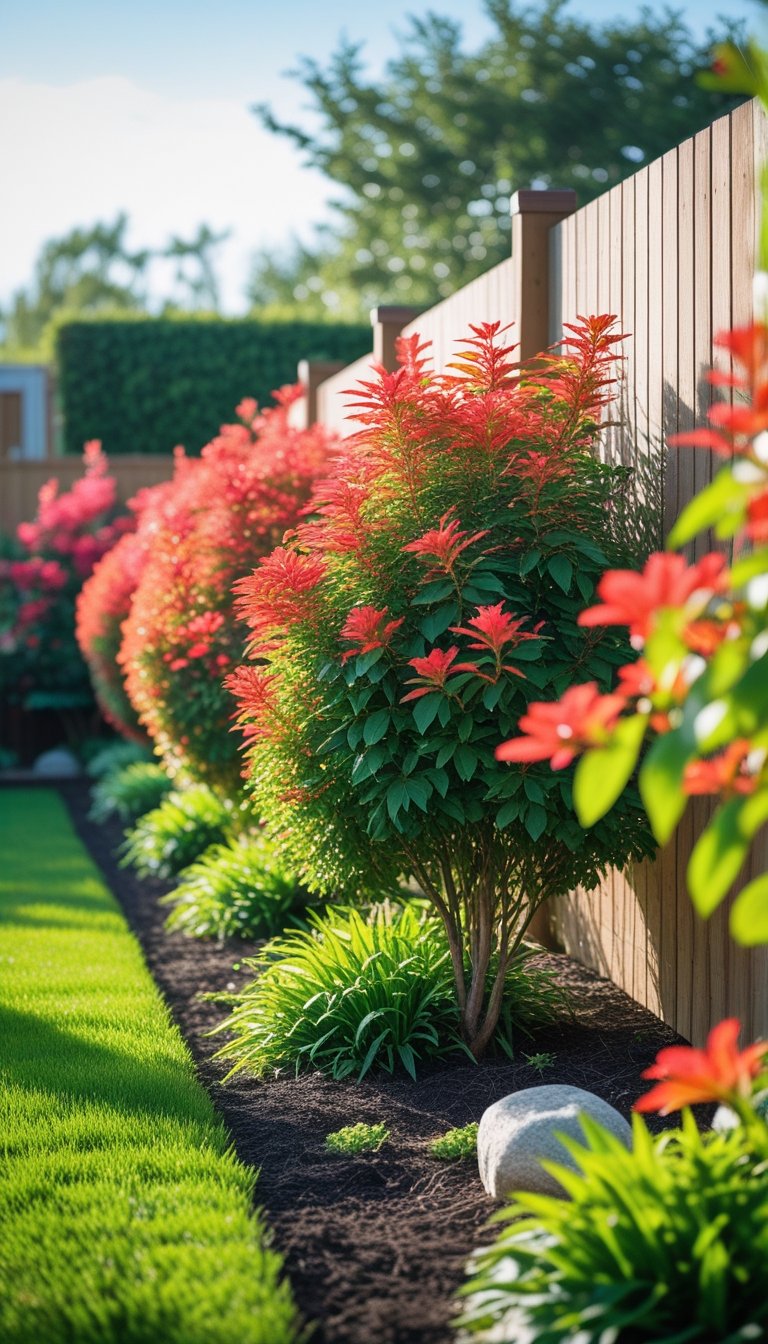
Photinia creates a dense screen with bright red new growth. Many gardeners choose Red Tip Photinia privacy hedge growth tips to guide planting and pruning.
It grows best in full sun and well-drained soil. Regular trimming keeps the hedge thick along the fence line.
11) Holly trees for year-round dense, prickly barriers

Holly trees create thick, evergreen screens along fences. Their glossy leaves and sharp edges form a strong physical barrier.
Many varieties grow tall and dense, including Nellie R. Stevens holly for privacy screens. They keep their leaves all year and produce red berries in fall.
12) Privet for classic, fast-growing hedges

Privet forms a dense hedge that works well along a fence line. Many gardeners choose it for its neat look and quick growth.
Several types rank among the fast-growing privacy hedges for home landscapes. It tolerates pruning and holds its shape with regular trimming.
13) Magnolia Grandiflora for broadleaf evergreen privacy

Magnolia grandiflora creates dense, year-round screening along a fence. Its thick, glossy leaves block views and reduce noise.
This tree grows tall and wide, so they should space it well. Many gardeners choose it for evergreen magnolia privacy screening. It thrives in full sun and adapts to urban sites.
14) Hornbeam for a neat, deciduous privacy screen

Hornbeam forms a dense canopy that works well along a fence line. European hornbeam creates one of the densest deciduous canopies for privacy screening.
It tolerates pruning and keeps a tidy shape. Many gardeners use pleached hornbeam for privacy and screening in narrow spaces.
15) Portuguese Laurel for dense, glossy leaves

Portuguese laurel forms a thick hedge with dark, glossy leaves that stay green all year. It suits homeowners who want steady coverage along a fence.
It grows as a shrub or small tree and responds well to trimming, making it ideal for a dense privacy hedge. In spring, it produces fragrant white flowers and later small purple berries, as noted by NC State Extension.

